
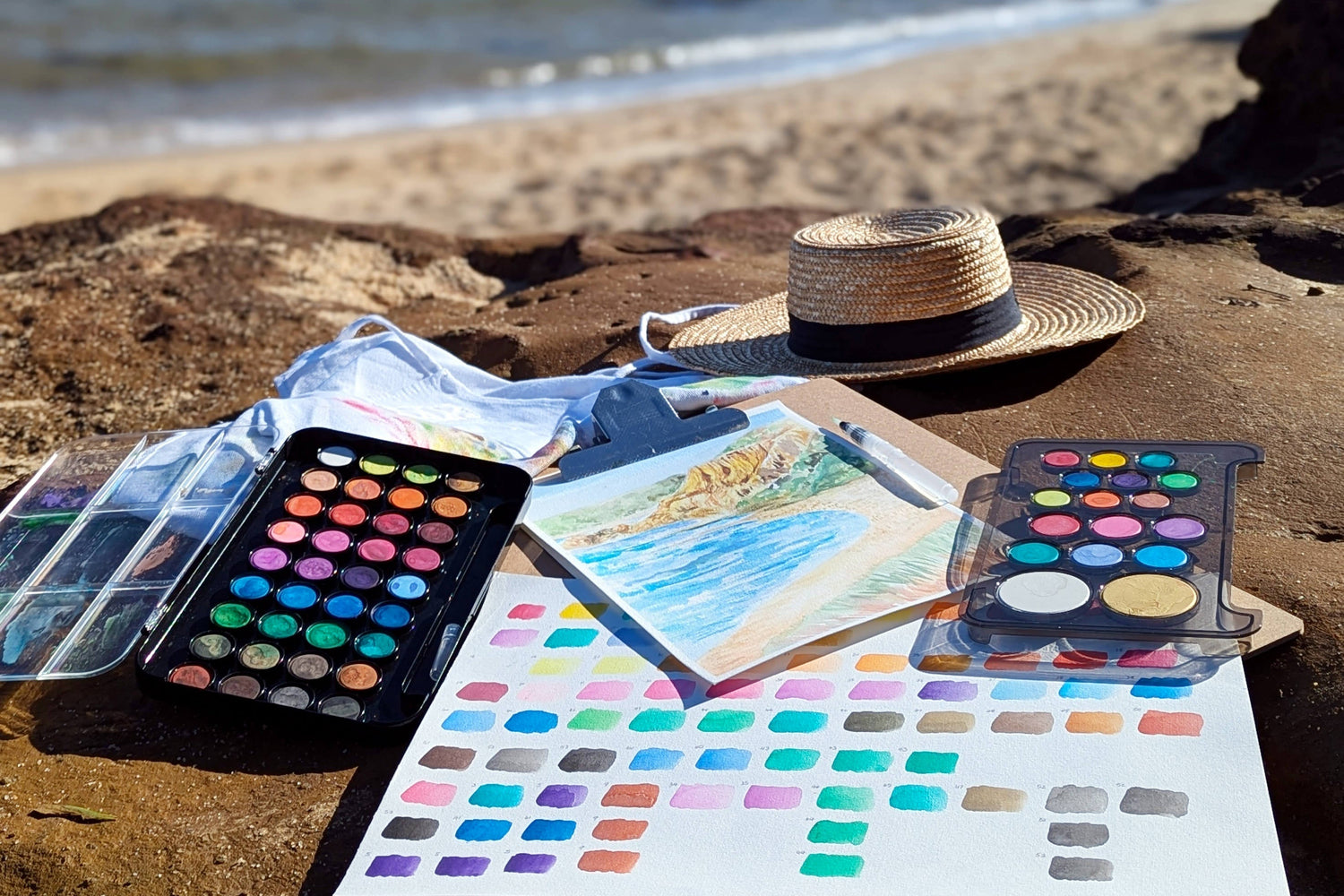
Why Your Colours Turn Brown
You mix what looks like a perfect secondary, and it comes out as mud. You've just experienced subtractive mixing, and until you understand how it works, this will keep happening.
The colour wheel you learned in school shows red, yellow, blue as primaries. That's additive theory (light). Paint works differently. When you mix paints, wavelengths subtract from the light reflected back. A "true" red paint isn't pure red—it leans warm or cool depending on its pigment source. Mix a cool red with a warm yellow, and their opposing tendencies cancel into brown.
This is the core problem most painters don't know they have.
The Split-Primary Palette System
The solution is deliberate. Instead of one red, one yellow, one blue, work with two versions of each primary: a warm and a cool.
Reds:
- Warm red (red-orange bias): cadmium red, alizarin crimson, pyrrole red
- Cool red (red-violet bias): alizarin, quinacridone magenta, permanent rose
Yellows:
- Warm yellow (yellow-orange bias): cadmium yellow deep, Indian yellow, raw sienna
- Cool yellow (yellow-green bias): cadmium yellow light, lemon yellow, bismuth yellow
Blues:
- Warm blue (blue-green bias): cerulean, viridian, prussian blue
- Cool blue (blue-violet bias): ultramarine, cobalt, indigo
Why this matters: mixing warm red + cool yellow = clean orange. Mixing cool red + warm yellow = also clean orange, but slightly different. With split primaries, you control not just hue but also intensity and undertone.
Test this yourself. Mix cadmium red (warm) with lemon yellow (cool). Notice the orange clarity? Now mix alizarin (cool) with cadmium yellow deep (warm). Still orange, but it shifts toward brown. Neither is "wrong"—you're just choosing which version you want.
Subtractive Mixing in Practice
Light travels through paint and bounces back. The more pigment you add, the less light returns. Mixing two colours = mixing two pigment sets, which absorb more wavelengths together than apart.
This means:
- Adding white lightens but dilutes intensity (each additional pigment absorbs wavelengths)
- You can't "brighten" a mixed colour by adding more pigment
- Three-pigment mixes muddier faster than two-pigment mixes
The practical rule: limit mixes to two or three pigments. Two is cleaner. When you need four colours in one mix, you're usually fighting against the pigments themselves rather than blending them.
Colour Temperature and Why It Matters
Every colour has temperature. It's not metaphorical—it's about pigment bias.
Ultramarine blue contains red. It's a cool blue that leans violet. Cerulean contains green. It's a warm blue that leans cyan. Mixing ultramarine + cadmium red produces a different purple than cerulean + the same red, because ultramarine is already pulling violet-ward.
In practice, this governs your palette range:
- Shadows with temperature: cool shadows are ultramarine + alizarin. Warm shadows are burnt sienna + ultramarine. The temperature shift reads as depth.
- Greens need temperature control: cadmium yellow light + cerulean = cool, luminous green. Cadmium yellow deep + viridian = warm, earthy green.
- Neutrals and greys: grey isn't grey without colour. Payne's grey + warm yellow = greenish grey. Payne's grey + cool red = purplish grey.
Recognising temperature in your pigments lets you mix with intention instead of accident.
Mixing Secondary Colours (and Why Clean Ones Matter)
Secondary colours (orange, green, violet) should sing. They rarely do without intention.
Clean orange: equal parts warm red (cadmium) + warm yellow (cadmium deep). If you add cool yellow, it dulls toward brown. Adjust the ratio to shift toward red-orange or yellow-orange, but keep both pigments warm.
Clean green: this is where split-primary saves you. Cool yellow (lemon) + warm blue (cerulean). Warm yellow (cadmium deep) + cool blue (ultramarine) also works but reads earthier. Viridian straight from the tube is pre-mixed green; it's useful but limits what you can adjust.
Clean violet: equal parts cool red (alizarin, permanent rose) + cool blue (ultramarine). Warm red into cool blue = muddy purple because they fight. Keep both cool.
The pattern: match temperature across the mix. Warm + warm = clean colour with warmth. Cool + cool = clean colour with coolness. Mixed temperature = compromise colour.
Creating Neutrals and Greys from Complements
Grey doesn't exist in nature or paint. Every grey is a colour. The question is which colour's grey you want.
Mixing complementary colours (opposite on the colour wheel) produces neutral tones:
- Red + green = brownish grey
- Yellow + violet = warm grey
- Blue + orange = cool grey
Why complements? They contain all three primaries together. Red + green (which is yellow + blue) = red + yellow + blue = theoretically neutral. In practice, you get a grey with the temperature bias of whichever complement you weighted more heavily.
To mix a neutral grey: start with the dominant colour you want neutrality in (say, blue shadow). Add its complement (orange) in small amounts. The orange neutralises the blue's intensity without turning the mix brown. You control whether the grey feels cool (more blue + less orange) or warm (more orange + less blue).
For absolute neutrals, mix complementary pairs in a 1:1 ratio using equal pigment weights. This works best with high-intensity complements like cadmium yellow + ultramarine violet.

Practical Mixing Exercises
Exercise 1: Temperature Matching
Mix three versions of orange using the same warm red (cadmium). Use three different yellows: lemon (cool), cadmium yellow (neutral), cadmium yellow deep (warm). Notice the shifts in the orange. The cool yellow version should look brighter; the warm version earthier. This trains your eye to see temperature bias in pigments.
Exercise 2: Secondary Range
Using split primaries, mix one clean orange, one clean green, one clean violet. Don't adjust ratios yet. Get the clearest version of each. Then mix variations: shift the orange toward yellow-orange and red-orange. Shift green toward yellow-green and blue-green. This builds muscle memory for ratio and pigment selection.
Exercise 3: Complement Mixing
Create a neutral grey using three different red-green combinations. Try cadmium red + viridian. Try alizarin + cadmium yellow light. Try pyrrole red + prussian blue. Write down which combination feels most neutral and which feels most obviously coloured. You'll start recognising which complements work together at the pigment level.
Exercise 4: Three-Pigment Mixes
Take one subject (a leaf, an apple) and mix its colour using two pigments. Then try a three-pigment version using the same hues. Compare intensity. Most artists find the two-pigment version cleaner. The three-pigment version often needs white to recover brightness, which tells you the third pigment was unnecessary.
Troubleshooting Muddy Mixes
If your colour is muddy, check three things in this order:
-
Pigment temperature mismatch. Confirm you're mixing warm + warm or cool + cool. If you've mixed opposing temperatures, accept the muddy result and start with fresh pigment. Don't try to "fix" by adding more colour.
-
Too many pigments. Remove one. If you've mixed three or four colours and the result is muddy, likely one pigment is fighting the others. Use a two-colour version instead.
-
Pigment bias unknown. Some pigments are notorious wildcards. Ultramarine violet is actually blue with red in it. Viridian is actually blue-green, not true green. If your pigment container doesn't specify the hue (yellow, orange, violet bias), test it against known warm and cool versions. A swatch test takes two minutes and saves hours of mystery muddy mixes.
Building Your Working Palette
Start with six pigments: warm and cool versions of red, yellow, blue. Add white. This is sufficient for mixing every colour you'll need.
As you grow, add a second green (viridian or prussian blue for cool greens). Add a neutral (raw sienna, burnt sienna, or ochre). Add a grey (Payne's grey) only if you struggle with mix consistency; it's a crutch that usually signals you haven't mastered complement mixing yet.
Avoid pre-mixed secondaries and "earth tone" sets. They limit your mixing range. The slight investment in learning split-primary mixing pays dividends across every painting technique.
Conclusion
Colour mixing isn't mystical or dependent on "talent." It's about understanding what happens when light travels through layered pigments and recognising temperature bias in the paints you're using. A split-primary palette and deliberate ratio control give you the mechanics. The rest is observation and practice.
Test. Mix. Look. Adjust. This isn't theory anymore - it's craft.
Ask Klumpf about colour mixing, primary palettes, or why your mixes go muddy. Micador's in-house art expert. Bottom-right of every page.
Next in this series: "Beyond Paint: Clay, Markers, Printmaking and Mixed Media"
© 2026 Micador Group. All rights reserved. This article is original editorial content produced by Micador. You're welcome to link to it or quote short passages with attribution. Reproducing the article in full, or republishing it on another platform, requires written permission — amazing@micador.com.au.

Leave a comment
All comments are moderated before being published.
This site is protected by hCaptcha and the hCaptcha Privacy Policy and Terms of Service apply.