
There's a particular kind of tired that a screen can't fix. You know the one. You've scrolled everything, watched something, and somehow feel worse than when you sat down.
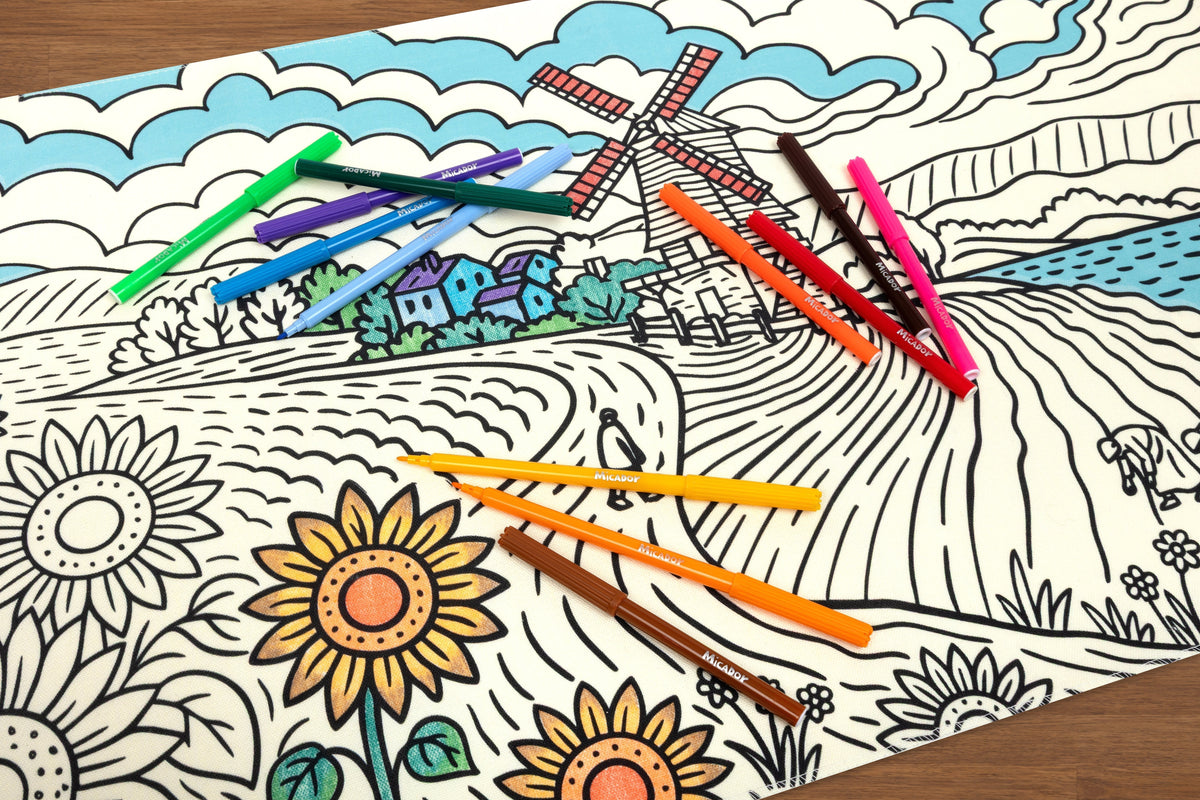
We built something simpler: a 150 centimetre canvas that lives on your table, waiting to be coloured in.

Three times art went outside the lines
Every rule in art was once just somebody's good idea. The correct subject. The correct palette. The correct amount of finish. Then somebody worked outside it, got told off in print, and turned out to be right.
That's what the first three Table Canvases are: not styles picked for how they'd sit on a table, but three moments when the people making art decided the rules were a suggestion.
The man who never finished art school
Vincent van Gogh (1853 to 1890) was self-taught. He learned from books, worked through colour theory on his own, and copied other artists to find out how they'd done it. He enrolled at the Antwerp Academy in 1886 and lasted a few months.
What he was after he found in Paris instead, in two places at once: the Impressionists, and Japanese woodblock prints. "All my work is based to some extent on Japanese art," he said, a striking thing to hear from a painter we now treat as a starting point for modern art.
What followed broke nearly every rule a trained painter was taught. Colour chosen for how it felt, not how it looked. Brushwork left visible instead of smoothed flat. A night sky that swirls, because that's what a sky does if you stand under it long enough. Contemporaries who watched him work weren't sure if it would end in ruin or genius. It turned out to be both, in the wrong order.
Walk with Van Gogh is a walk across that same ground: start in the Sunflowers of 1888, move through Green Wheat Field with Cypress and Starry Night in 1889, and finish with Two Peasant Women Digging from 1890, his last year. Washable fabric markers included.
The exhibition painted on cigar-box lids
Arthur Streeton (1867 to 1943) was born in the gold-rush era, when Australian painting still meant European painting done at a distance. Not long after, he was painting alongside Tom Roberts and Frederick McCubbin at their camp at Box Hill, working outdoors, in the actual glare. What came out of it was the Heidelberg School, Australia's first major art movement.
Their most pointed act was an exhibition. In August 1889 they hung 183 paintings, most worked on cedar cigar-box lids nine inches by five, and called it the 9 by 5 Impression Exhibition. Small, fast, unapologetically unfinished. One Melbourne critic tore into it so viciously that the review ended up pinned to the exhibition door, and the crowds came anyway, some just to see what the fuss was about. The catalogue's own answer to that fuss was blunt: an effect is only momentary, so an impressionist tries to find his place.
Their own idea is now what Australia looks like in paint. A high-key palette. Broken colour, so the light appears to move. Distance rendered in blue. "Nature's scheme of colour in Australia is gold and blue," as Streeton put it.
Walk with Streeton follows that scheme, from Princes Bridge in 1888 out to Surveyor's Camp in 1896 and into Blue and Gold in 1904. It's a slower canvas than the Van Gogh, and it's meant to be.

The art that refused to be precious
Ukiyo-e ran from 1603 to 1868, and its name changed meaning on the way. "Ukiyo" began as a Buddhist term for the "world of sorrow", the passing world you were meant to look past. Seventeenth-century Edo turned it over and read it as the "floating world" instead, a case for living in the moment. Asai Ryoi described that world in 1661 as "refusing to be disheartened, like a gourd floating along with the river current".
The genuinely disobedient part was technical. These were prints, not paintings. Woodblock, editioned, produced in numbers, so art stopped being one precious object for the wealthy and became something an ordinary person in Edo could own. In 1765 Suzuki Harunobu worked out full-colour printing using multiple carved blocks, and the form opened up. Hokusai produced over 30,000 works and made The Great Wave at seventy. Hiroshige turned a road into the Fifty-three Stations of the Tokaido.
The look came with the method: bold outlines, flat fields of colour, atmospheric perspective, pattern where a European painter would put realism. When the prints reached Europe in the 1860s they reorganised how Monet, Whistler and Van Gogh saw a picture, which is the quiet link between these three canvases. Rule-breaking travels.
Walk through Ukiyo-e is the floating world across 150 centimetres, waves and bridges and blossom, waiting on your colour.
Why they're walks
You walk with a person. You walk through an experience. That's the whole naming logic: two artists you keep company with, one world you move about in.
Each canvas comes with a brochure on the artist or movement, so the walk has something under it, and each ends with a line of its own. Van Gogh's is the best art advice going: See what you see. Streeton's: It's ok to take your time. Ukiyo-e's: There's no wrong way to float.
Washable is not about the mess
Everyone assumes washable is for kids' sake. On a Table Canvas it's for yours.
Permanence is quietly paralysing. It's why so many adults own art supplies they've never opened: the fear of ruining the nice thing. A canvas that washes clean removes the fear entirely. Try a colour that shouldn't work. Go outside the lines on purpose. If you change your mind, water changes it back, and the same canvas becomes a different walk next month, again and again.
There's no finished state to fail at. There's just the time you spend on it.
Where it lives
On the table, ideally left out. A Table Canvas half-coloured is not an unfinished job, it's an open invitation, to you at the end of a long day, or to whoever wanders past and picks up a marker. Some of ours have been coloured by four different hands in a week, and the canvas is better for it.
Take your time. The canvas isn't going anywhere, and neither is the walk.


Leave a comment
All comments are moderated before being published.
This site is protected by hCaptcha and the hCaptcha Privacy Policy and Terms of Service apply.