
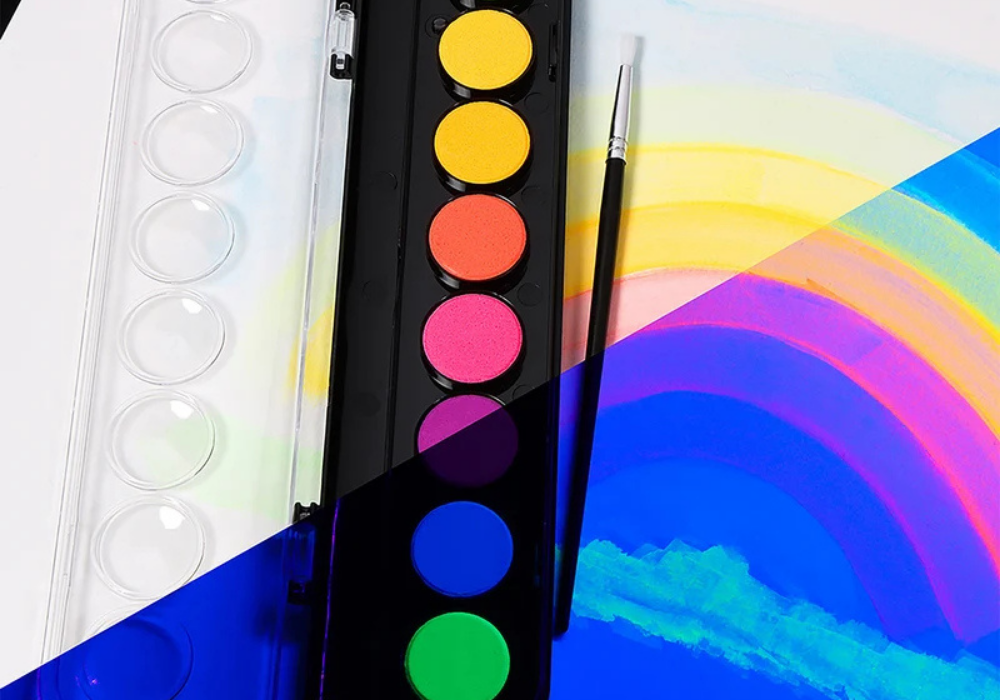
Red at one end, violet at the other. That's the whole of what your eyes can see, and it's a much narrower slice than most of us assume.
Infrared means below red. Ultraviolet means beyond violet. Two words we've all been saying our entire lives without noticing they're just directions: one step past each end of the rainbow, into light that is absolutely still there and still doing things. We simply can't see it.
Your TV remote is firing infrared across the lounge room right now. And a black light, like our Dark Arts Magic Black Light, is firing ultraviolet at your Halloween decorations, which is exactly why the decorations light up and the room stays dark.
That's the science of light, and October is the best week of the year to show a kid how it works. Every house fills up with things that glow, everyone is already slightly overexcited, and at some point with the lights off somebody asks how it works. Most of us shrug. You don't have to.
Here's the bit nobody tells you. Two completely different kinds of glow sit side by side on the same shelf, and they work in opposite ways. Turn the black light off. If the thing goes dark instantly, it's fluorescent, passing light straight through and out the other side. If it keeps glowing with nothing shining on it, it stored the light and is handing it back slowly.
Same shelf, opposite physics. Once a kid has that, the decorations stop being decorations.
One planning note: Halloween here is mid-spring, and in the daylight saving states it isn't properly dark until around 8:15pm, which is after the people most excited about this have gone to bed. A blacked-out bathroom on the Saturday before beats the night itself.
First, the Three Ways to Make Light
Fluorescence. The material takes in light you can't see and hands back light you can, in about ten nanoseconds. Take the source away and it stops dead. Highlighters, neon paint, the white bits of a costume. A very fast relay, not a storage cupboard.
Persistent luminescence, or what everyone calls glow-in-the-dark. The material parks some of that energy in defects in its crystal structure, then leaks it back out as room temperature shakes it loose. That's why it needs charging and fades on a curve instead of switching off. It behaves like a battery you charge with light, except it starts leaking the second you stop and there's no off switch.
Bioluminescence. A living thing makes its own light with a chemical reaction, usually an enzyme called luciferase working on a substrate called luciferin. Nothing shines in at all. Fireflies, glow worms, and the sea sparkle that turns Port Phillip Bay blue.
One line for a kid: fluorescence needs the torch on, glow-in-the-dark needs the torch first, bioluminescence needs no torch at all.
Why Ultraviolet Goes In and Colour Comes Out
A photon of ultraviolet kicks an electron up a level. It lands untidily, sheds the extra as heat, drops back down and sheds a bit more. Both losses push the light coming out to lower energy, which means longer wavelength, which means you can finally see it.
That's the Stokes shift, after George Gabriel Stokes, who described it to the Royal Society in 1852 and coined the word fluorescence in a footnote he clearly wasn't confident about. It also means the trade only runs one way. Some energy is always paid out as heat, so there's no free light.
Worth knowing about your torch. Ultraviolet comes in three bands: UVA from 315 to 400 nanometres, UVB 280 to 315, UVC 100 to 280. Sunlight's UVC never reaches the ground, absorbed on the way down by ozone and oxygen. A black light is a UVA source, and the Micador Dark Arts Magic Black Light sits right in that band. Anything sold as UV at 405 nanometres is just purple light with ambition, and phone UV apps do nothing at all.
Want to Test That Out With the Kids?
Ten experiments, easiest first, about five minutes each. You'll want the Dark Arts Magic Black Light for most of them, and everything else is already in the kitchen, the laundry or the chemist. All adult-supervised, and the Magic Black Light isn't a toy: keep it off faces and out of eyes.
1. The Ghost Shirt
Shine the Magic Black Light on a white cotton shirt and something unbleached next to it. Calico, natural wool, or a shirt that's spent a summer on the line. The white one lights up blue-white. The other barely bothers.
It's not the cotton, it's the brighteners. Most laundry powders carry optical brighteners, usually stilbene derivatives, which soak up ultraviolet between 340 and 380 nanometres and hand it back as blue-violet. That extra blue cancels the yellow cast fabric picks up as it ages, so your eye reads it as whiter than white. A marketing claim that turns out to be literally true, just not how anyone assumed.
Two traps: mills add brighteners at manufacture, so a brand-new unwashed shirt glows just as hard, and plenty of eco and sensitive detergents leave them out entirely.
2. Frozen Potion Cubes
Freeze tonic water into cubes, lights off, Magic Black Light on them in a bowl. Electric blue. For looking at, not drinking.
Quinine, the stuff that makes tonic taste like that, absorbs at about 347 nanometres and hands back blue at 450. It's so dependable that laboratories use it as a fluorescence reference standard. In Australia the Food Standards Code allows up to 100 milligrams per kilogram in tonic, so what's in the bottle is a very dilute solution doing a very loud job.
Bonus: dilute it half and half with water. Then again. Then again. Quinine stays visible when there's almost nothing left, which makes this a dilution series, a real laboratory technique your kid can run in a bowl.
3. The Glowing Vitamin
Crush a vitamin B2 tablet into a glass of water, lights off, Magic Black Light through the glass. Yellow-green, immediately. An adult does the crushing, ask the chemist for straight riboflavin rather than a multivitamin, and tip it out afterwards.
Riboflavin is vitamin B2 and it fluoresces yellow-green around 520 to 530 nanometres. Ten milligrams per litre is already an intense glow and any chemist dose clears that by ten to a hundred times, so this one can't really fail. It's also why milk in a clear bottle goes off in the sun: riboflavin absorbs the light, drives the reactions behind that flat off flavour, and gets destroyed doing it.
Bonus: add lemon juice and watch the glow die. Riboflavin's fluorescence disappears in acid, so that's a result, not a failure. And if you see a list telling you to use B12, ignore it. B12 doesn't glow.
4. Invisible Warning Notes
Squeeze a little yellow highlighter ink into water, paint a message, let it dry. Blank under normal light, burning green under the Magic Black Light.
Many yellow highlighters use a dye called pyranine, which fluoresces around 510 nanometres with a quantum yield close to one, meaning nearly every photon in comes back out as light. Others use different dyes, so raid the pencil case and test a few. On raw efficiency these beat quinine comfortably, which is slightly humbling for the tonic water.
5. Witch's Brew Runs Red
Destem five to seven spinach leaves and crush them to a paste. Cover with isopropyl alcohol from the chemist, leave half an hour, stirring now and then. Overnight in the fridge is better. Shine a bright white or blue torch through the jar. Blood red.
Skip the methylated spirits. Most Australian metho has fluorescein among its denaturants, and fluorescein glows green under UV all by itself, sitting over the top of the result you're trying to show. Adult handles the alcohol, well away from candles.
And put the Magic Black Light down for this one. Chlorophyll absorbs blue far more strongly than ultraviolet, so a plain white or blue torch wins here. The one experiment where the good gear loses.
The science is backwards, which is why it's the best thing on the list. A working leaf pushes the light it absorbs into photosynthesis and dumps the leftovers as heat on purpose, so only one to two per cent leaks back as red fluorescence. Strip the chlorophyll out and both exits are blocked, so about a third of the light comes straight back out as red. The glow isn't the plant working. It's the energy the plant can't use any more.
Spinach and basil deliver. Waxy natives like eucalypt extract badly. The jar fades over a few hours, which is normal.
6. The Charging Race
Charge identical glow stickers under different light sources for the same time, then take them into a dark room together and see who wins.
Two rules or it's meaningless. Use stickers, not glow paint, because paint fluoresces while a torch is on it and you're measuring stored charge. And the Magic Black Light stays out of the observation room, or everything fluoresces at once and your experiment becomes a disco.
The pigment in most glow products is strontium aluminate doped with europium and dysprosium, absorbing across 300 to 450 nanometres and peaking around 350 to 370. Sunlight should walk it. A warm incandescent lamp throws about 90 per cent of its energy out as heat and almost nothing into the near-ultraviolet, so it should charge slowly. The wrinkle: blue light at 444 nanometres actually produces a stronger afterglow than near-ultraviolet at the same intensity.
Predict, measure, explain. That's the entire scientific method in eight minutes, and nobody needs to know it was educational.
7. Spooky Eyes Down the Hallway
Stick glow stickers along a dark hallway at kid height, charge them with the Magic Black Light, take it out of the hallway, then walk it. Clear the floor first, for reasons that become obvious.
This is the clearest side-by-side you'll get. The stickers keep going with the Magic Black Light gone from the building. Put a neon painted page next to them and the neon vanishes the instant it leaves. Two materials, same wall, opposite behaviour.
Since somebody always asks: strontium aluminate is more than ten times brighter than the zinc sulfide it replaced and isn't a radiation source. Radium went into watch dials until the 1960s. Tritium is still used in some watches and exit signs, so "no glow product is radioactive" isn't quite true, but the sticker on your wall is.
8. The Glow Jack O'Lantern
Paint a pumpkin in glow paint, leaving the eyes and mouth bare. Charge it, lights out. A glowing pumpkin with black features, the exact inverse of a carved lantern and far less likely to set fire to the tablecloth. Bin it afterwards, since craft paint isn't food-safe.
This one usefully wrecks the tidy two-category story. While ultraviolet is on strontium aluminate, the europium atoms hand back light as fast as they take it in, which is ordinary fluorescence. At the same time some energy gets parked in crystal defects and trickles out over hours as afterglow. Same atoms, two speeds. Real materials are usually mixtures rather than textbook single effects, which is worth saying to a kid who's just been handed a clean rule.
9. Fridge Raid Forensics
Lights off, Magic Black Light on, rate everything out of ten. In order of how impressive they actually are:
- Turmeric. Champion of the spice rack. Dried powder emits around 550 nanometres, yellow-green.
- Teeth. Smile in the dark. Reliable blue-white, no prep, works on everyone in the room. Aim from below the chin with eyes closed. The glow comes mainly from the dentine underneath, which fluoresces about three times harder than the enamel over it.
- Olive oil. Deep red, but it's a setup: a genuinely green extra virgin, a clear glass, the beam through it, full darkness. Extra virgin gives a band at 525 nanometres plus chlorophyll at 681. Refined oils look different, which is genuinely how some laboratories check an expensive oil is what it claims.
- Banana spots. The brown speckles grow blue haloes. Those are fluorescent chlorophyll catabolites, the wreckage of chlorophyll as the fruit ripens. Only works at middling ripeness: green and black bananas both let you down.
- Honey. Faintest of the lot, and some honeys give almost nothing. Try two jars before blaming the Magic Black Light.
One to skip: petroleum jelly. The internet has been confidently telling people to smear Vaseline on things for as long as there have been glow lists, and it barely does anything. Purified petrolatum is saturated hydrocarbon, which can't absorb in this range at all. Why does every second science page insist otherwise? They use 365 nanometre lamps and smear it on paper, which is stuffed with optical brighteners that glow blue without any help. There's also a naming trap: Vaseline glass is antique uranium glass, which really does blaze green and has nothing to do with the stuff in the tub.
Extension: raid the pencil case. Some neon pigments fluoresce and some are just very loud colours that don't, and nobody in the room knows which until you run it.
10. The Afterglow Countdown
Charge a glow item, then sit in the dark for two or three minutes before your first reading, because eyes need that long to adapt and without it the early numbers are junk. Fix your viewing distance and don't move. Rate brightness out of ten every minute until you can't see it. Plot minutes across, brightness up.
You won't get a straight line. You get a cliff in the first few minutes, then a long tail running for hours. That shape is trapped charge escaping from traps of different depths: the shallow ones empty fast, deeper ones need more thermal nudging, and the deepest just sit there waiting for heat that isn't coming.
Run it twice with two charging times and lay the curves over each other. Physics made visible, and a maths lesson in a costume.
Glowing Things You Can Go and Find
Sea sparkle. Noctiluca scintillans is a single cell about half a millimetre across that flashes blue when the water is disturbed. Recorded in Sydney Harbour since 1860, it stayed scarce for over a century, then from 1993 started forming serious blooms and is now one of Australia's most common, reaching Port Phillip Bay and Tasmania. In daylight the same bloom looks like tomato soup, which takes some of the romance out of it.
Glow worms. The ones at Natural Bridge in Springbrook National Park aren't worms. They're the larvae of a small fly, Arachnocampa flava, and they hang sticky threads to catch the midges that come toward the blue-green glow, which reframes the whole thing. Best viewing December to March.
Glowing mammals. In 2020, US researchers found platypus fur fluoresces green-cyan under ultraviolet, working from three museum skins. Headlines everywhere, obviously. Then in 2023 a team led by the Western Australian Museum tested 146 specimens across 125 species and every living mammal order. Koalas, wombats, echidnas and Tasmanian devils all glowed too.
Their conclusion was cautious: it looks like a general property of unpigmented fur, and it's unclear whether it does anything useful at all. Which is a better lesson than the headline was. A remarkable one-off becomes ordinary the moment somebody checks a hundred more cases, and the checking is the science.
Why We Care About This
We make art materials, and we're not going to pretend paint teaches physics. A torch and a white shirt teaches physics.
What art materials do is get a kid to care about the answer before anyone hands them the explanation. Different job, and the harder one. A kid who's just watched a jar of crushed leaves turn blood red will sit still for the reason why. A kid who got the reason first will be somewhere else entirely.

The Bottom Line
Infrared sits below red, ultraviolet beyond violet, and both are doing things you can't see.
Fluorescence hands the light straight back. Glow-in-the-dark stores it and leaks it out for hours. Bioluminescence skips the light entirely and makes its own.
Ten experiments, one Magic Black Light, most of the rest already in the cupboard. Turn the lights off and start with the shirt.
If you need the gear, the Micador Dark Arts range has the black light and everything else on this list.



Leave a comment
All comments are moderated before being published.
This site is protected by hCaptcha and the hCaptcha Privacy Policy and Terms of Service apply.